Fast Answer: BOMBANANA Is a Monkey Bomb-Defusal Game About Information Gaps
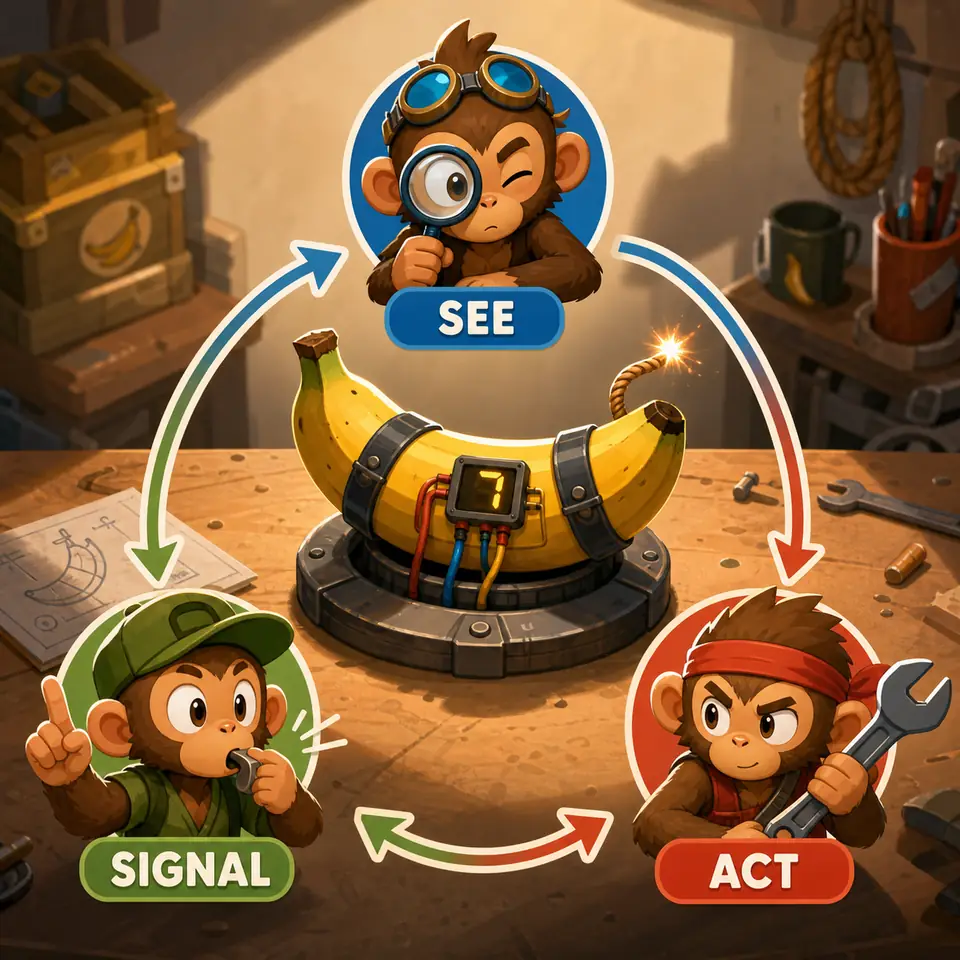
BOMBANANA gameplay is easiest to understand as a co-op translation problem. One player can interact with the banana bomb, one player has the manual logic, and one player becomes the bridge between what is seen, what is signed, and what can be safely spoken. If your team tries to play it like a normal voice-chat puzzle game, the role restrictions will feel awkward. If your team treats every clue as a short relay, the game starts to make sense.
The core loop is simple but tense: identify the module, describe only the information the manual reader needs, turn the manual branch into one action, repeat that action, and then press, cut, toggle, or wait. The timer creates urgency, but most first-run failures come from unclear handoffs rather than difficult controls. A good first BOMBANANA session should prove that the team can say “stop,” “repeat,” “left,” “right,” “confirmed,” and “solved” without inventing new meanings mid-run.
The 3 BOMBANANA Roles: What Each Player Actually Does
The role names sound silly, but the design is strict. The handler is closest to the bomb and should avoid guessing from memory. The manual reader is closest to the rule logic and should avoid flooding the team with every branch. The bridge watches the information chain and turns partial knowledge into one safe instruction. No role is the “main” player for the whole run; the team succeeds when all three roles stay narrow.
| Role | Job during a module | Best habit | Common failure |
|---|---|---|---|
| Bomb handler | Reports module state and performs the final action. | Describe first, act after confirmation. | Pressing before the manual branch is confirmed. |
| Manual reader | Turns the reported state into a rule branch. | Give the bridge one final action, not a lecture. | Reading too much of the manual aloud. |
| Communication bridge | Connects visible signals, spoken prompts, and final confirmation. | Repeat the action in the same words every time. | Changing “left” or “right” perspective mid-run. |
This page is deliberately separate from the manual guide. The manual guide helps you structure callouts and module decisions. This gameplay guide explains whether the whole loop is the kind of co-op pressure your group will enjoy.
How a Clean BOMBANANA Gameplay Loop Should Feel
- Scan: the handler names the module and reports the smallest useful state: count, color, direction, number, switch position, light, or symbol.
- Translate: the manual reader chooses a branch and strips the answer down to one action or one question.
- Confirm: the bridge repeats the final action and asks for a clear yes/no confirmation.
- Act: the handler performs the input only after confirmation, then reports whether the module changed or solved.
- Reset: after a mistake, the team restarts the callout instead of continuing from memory.
That loop makes BOMBANANA different from generic “bomb game” searches. The puzzle is not just which wire to cut or which button to press. The puzzle is whether three players with restricted information can keep one instruction intact. A slow first clear is better training than a chaotic near-win because it gives your group a reusable communication pattern.
Who Will Like BOMBANANA Gameplay?
BOMBANANA should fit players who enjoy co-op deduction, role-playing a limited point of view, and laughing at communication mistakes without turning the session into blame. It may not fit players who want solo progression, perfect information, competitive ranking, or a long list of unlockable upgrades. The best comparison is not a normal action game; it is a social puzzle where the team’s shared vocabulary becomes the real controller.
| Player type | Fit | Why |
|---|---|---|
| Three friends on voice chat | Strong fit | The fixed roles give the group a natural reason to talk, pause, and review mistakes. |
| Solo puzzle player | Weak fit | The design depends on missing information across multiple people. |
| Keep Talking-style teams | Strong fit | The fun comes from converting manual logic into short, safe instructions under pressure. |
| Download hunters | Use caution | The correct route is Steam; unofficial mirrors do not improve the gameplay experience. |
First-Run Mistakes to Avoid
Most new teams fail because they talk too much, not because they lack puzzle intelligence. The handler gives a partial description, the manual reader jumps to a branch, the bridge changes the words, and the final action arrives slightly wrong. Fix that by agreeing on a tiny signal set before the timer starts. You need words for yes, no, repeat, stop, left, right, wait, and solved. Anything more can be added after one successful run.
Do not build your first session around a full walkthrough. Use walkthroughs and community guides as context, but keep the demo run honest. If a module changes after an input, stop and describe it again. If a player hesitates, ask for repeat instead of guessing. If two players disagree, freeze the handler. These boring habits are what make the game readable under pressure. For a dedicated seven-step sequence, see the BOMBANANA walkthrough.
BOMBANANA Gameplay FAQ
What kind of game is BOMBANANA?
BOMBANANA is a three-player online co-op bomb-defusal puzzle game built around blind, mute, and deaf monkey role restrictions.
Can BOMBANANA be played solo?
The official premise is built around three distinct players. A solo mode is not something this guide can confirm from current Steam information.
Is BOMBANANA the same as a manual puzzle game?
It shares the idea of manual-based deduction, but the monkey role restrictions make communication and perspective management the main challenge.
Where should I download BOMBANANA?
Use the official BOMBANANA Steam page or main Steam page. Do not use APKs, browser clones, repacks, or mirror installers.
What should a new team practice first?
Practice yes/no/repeat/stop signals and one slow module. Speed matters only after the team can pass one instruction accurately.
What should I read next?
Use the manual guide for callout rules, the system requirements page for device checks, and the price page for launch status.
Sources and Scope
This gameplay guide uses official Steam pages for verified game, demo, platform, and release facts. Community guide pages were used only to understand common module and callout coverage; Steam remains the source of truth for downloading and release-period details.