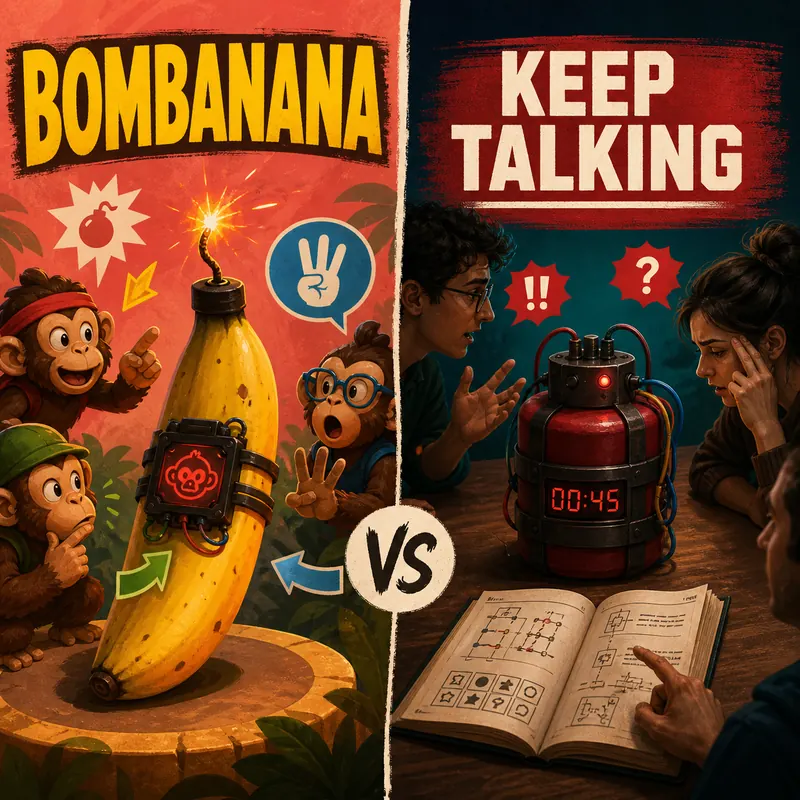
Quick Verdict: Pick by Team Shape
BOMBANANA is the cleaner choice for a fixed three-person online team. Its official Steam description presents a 3-player co-op team of blind, deaf, and mute monkeys, with each player holding only part of the needed information. That makes the number of players part of the puzzle rather than a casual recommendation.
Keep Talking and Nobody Explodes is the more flexible choice for two or more people. Its official Steam page calls it a local co-op party game for two or more players: one player handles the bomb while the other players use the manual. You can play remotely through voice chat or Remote Play Together, but the core social format is still the same-room manual-and-defuser split.
So the answer to BOMBANANA vs Keep Talking and Nobody Explodes is not that one game is universally better. BOMBANANA fits a three-player role chain; Keep Talking fits a flexible manual team. Start with your headcount, then choose the kind of communication pressure your group actually enjoys.
BOMBANANA vs Keep Talking: Comparison Table
The table separates first-party facts from the practical team implication. The official pages were checked on 24 August 2026. Store labels and availability can change, so use the linked page again before planning a purchase or session.
| Decision point | BOMBANANA | Keep Talking and Nobody Explodes | What it means for your team |
|---|---|---|---|
| Player count | Exactly 3 players in the official Steam description; the listing says three monkeys are required. | Two or more players in the official Steam description. | Pick BOMBANANA for a committed trio; pick Keep Talking if your group size changes. |
| Information asymmetry | Role-based sensory limits: the blind, deaf, and mute monkey roles create different missing pieces. | One defuser sees the bomb; one or more experts have the manual but cannot see the bomb. | Both demand precise callouts, but BOMBANANA spreads the role identity across three players. |
| Primary co-op label | The main Steam listing highlights Online Co-op. | The official site labels it Local Co-op; Steam says it is usually played in person and can be played remotely with voice chat. | Do not treat remote voice chat as the same thing as a native online-lobby design. |
| Best default group | Three friends who want every person to have a constrained job. | Two or more friends, a couch group, or a team willing to share the manual role. | Headcount and role tolerance matter more than the fact that both games contain a bomb. |
| Conversation style | Fast sensory translation between several distinct role perspectives. | Questions and answers between the defuser and manual readers. | Choose BOMBANANA for role chaos; choose Keep Talking for manual lookup and verbal deduction. |
BOMBANANA Player Count: Exactly Three
The official BOMBANANA Steam page is unusually direct about team size. It describes a 3-player co-op team and its feature list says "No more, no less" and "Exactly three monkeys required." For a player-count comparison, that is stronger than a generic Multiplayer or Co-op tag. It tells you to plan around three roles instead of assuming that any number of friends can fill the session.
The three-player requirement also changes how a team communicates. The official description says each player has only part of the needed information. In practical terms, the group cannot rely on one person seeing the bomb and another person reading a manual while everyone else watches. The role identity is part of the challenge: a teammate may have the relevant clue but not the sensory access or communication freedom to deliver it in the simplest way.
That is why BOMBANANA suits a group that likes assigned jobs and imperfect information. It may feel less forgiving if someone wants to rotate in and out, if only two people are available, or if the team prefers everyone to inspect the same screen. The fixed count is a feature for the right trio and a hard constraint for the wrong group.
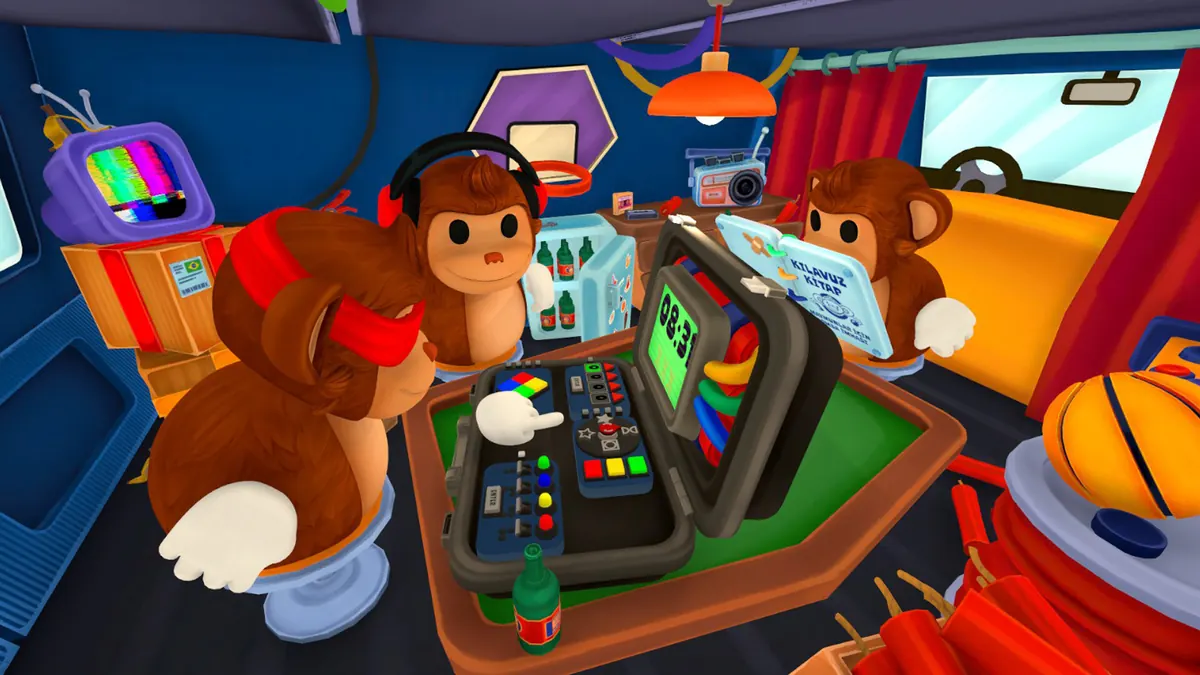
When three players is the point
- You already have three friends available for the whole session.
- Your group enjoys role limits instead of shared access to every clue.
- You want an online co-op listing and are comfortable checking the current Steam build.
- You want the communication failure itself to be part of the puzzle.
Keep Talking Player Count: Two or More
Keep Talking and Nobody Explodes uses a wider player-count promise. The official Steam page calls it "A local co-op party game for two or more players." The same description explains the central arrangement: the defuser is trapped with the ticking bomb, while friends have the manual and cannot see the bomb. The manual can be shared among several experts, so the group does not need to stop at a fixed three-person role chain.
That flexibility makes Keep Talking easier to schedule. Two people can play the core format, while a larger room can divide manual sections or take turns as the defuser. The tradeoff is that the game does not give each person a distinct sensory character in the same way. The important split is between the person who can act on the bomb and the people who can interpret the manual.
The phrase "two or more" should not be read as "every group size feels identical." Two players create a focused question-and-answer loop. Several experts can create a lively party, but they also need one person to coordinate the final answer. The more voices a team adds, the more useful clear module names and a single final caller become.
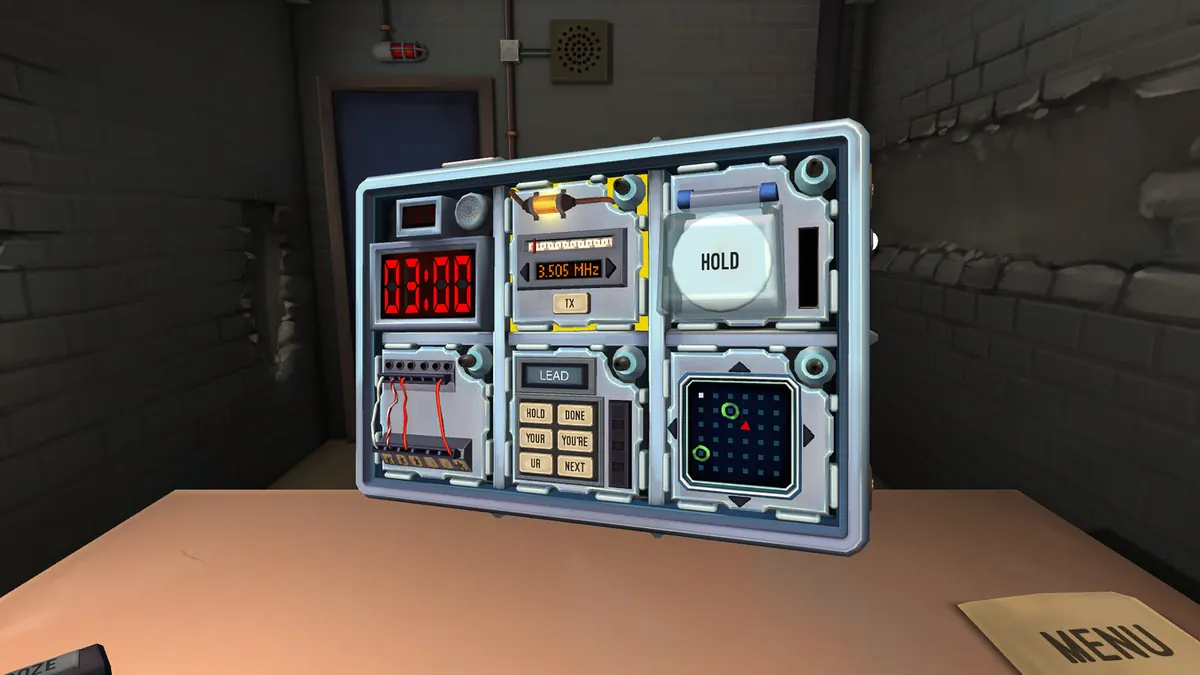
When flexible headcount is the point
- You may have two players today and a larger group another day.
- Your team likes one person operating while others search or explain manual rules.
- You want a local party format and can move to voice chat when playing remotely.
- Your friends are happy to share the expert role rather than each having a unique character restriction.
Information Asymmetry: Similar Idea, Different Shape
Information asymmetry means the team does not begin with one shared view of the puzzle. That is the common thread between these games, and it is the reason players compare them. But the missing information travels through different channels.
In BOMBANANA, the asymmetry is attached to the three monkey roles. The official description names blind, deaf, and mute players and says each person has only part of the information. A useful team habit is to think in terms of a chain: observe what your role allows, pass the relevant signal, wait for the next player to translate it, then confirm the action. No single player is meant to be the complete source of truth.
In Keep Talking, the asymmetry is more legible: the defuser sees and touches the bomb, while the experts see the manual. The experts can reason about the rule, but they cannot directly inspect the module. The defuser can inspect the module, but must describe it accurately before the manual answer becomes useful. This makes the game a classic manual-based communication exercise.
Online vs Local Co-op: Read the Labels Carefully
The online-versus-local question is more nuanced than a simple winner. BOMBANANA's main Steam listing highlights Online Co-op, which makes it the more natural starting point for a remote trio. Keep Talking's official site describes the game as Local Co-op, while its Steam description says the usual setup is in person and that remote play is possible through a third-party voice chat service. Steam also exposes Remote Play Together for the title.
Those statements are compatible. "Local co-op" describes the original social structure: everyone can be in the same room, with one screen for the defuser and a manual for the experts. "Remote" describes how a group transports that conversation over a call or remote-play feature. A remote session can preserve the local-style roles without turning the game into the same kind of online lobby as BOMBANANA.
| Your priority | Better starting point | Why |
|---|---|---|
| Three remote friends with fixed roles | BOMBANANA | Its official listing leads with online co-op and exactly three players. |
| Two people on one couch | Keep Talking | Its official positioning starts with local co-op for two or more. |
| Remote friends who already use voice chat | Either, after checking the current listing | Transport is only one factor; the role structure determines how the conversation feels. |
| Unpredictable group size | Keep Talking | Two or more is more forgiving than an exactly-three team requirement. |
Which Game Fits Your Team?
Use this decision order before you open a store page: count the available players, decide whether everyone wants a distinct restriction, then choose the connection method. The bomb theme is the least useful part of the decision because both games already share it.
Choose BOMBANANA if your team is a committed trio
BOMBANANA is the better fit when three friends can stay together and want the role design to create pressure. It makes sense for a remote group that enjoys fast callouts, unusual sensory limitations, and the feeling that one missing sentence can break the whole chain. The fixed player count may be exactly what makes the session feel intentional instead of like a generic party game.
Choose Keep Talking if your group needs flexibility
Keep Talking is the better fit when the player count may be two, three, or more, or when the group wants a straightforward defuser-and-manual arrangement. It also fits a local party more directly. The remote option works best when everyone already has a reliable voice channel and agrees on who will make the final call.
Use this five-minute team check
- Count the people. If you have exactly three and want distinct jobs, BOMBANANA moves up. If you have two or a changing roster, Keep Talking is safer.
- Choose the information gap. Pick BOMBANANA for three character-based constraints. Pick Keep Talking for the classic bomb-versus-manual split.
- Choose the room. For a same-room party, Keep Talking's local framing is a natural fit. For a remote trio, begin with BOMBANANA's online co-op listing.
- Choose the argument you want. BOMBANANA creates role translation problems; Keep Talking creates manual lookup and description problems. Both need a calm final caller.
BOMBANANA vs Keep Talking FAQ
How many players does BOMBANANA need?
The official BOMBANANA Steam listing describes a 3-player co-op team and says exactly three monkeys are required. For this comparison, treat three players as the intended team size.
How many players does Keep Talking and Nobody Explodes support?
The official Steam listing describes it as a local co-op party game for two or more players. One player defuses while one or more friends use the manual.
Is BOMBANANA online or local co-op?
The main BOMBANANA Steam listing highlights Online Co-op. Store metadata can change by product and build, so check the current listing for the exact version your team plans to play.
Is Keep Talking and Nobody Explodes online or local co-op?
The official site positions it as Local Co-op. Steam says it is usually played in person but can be played remotely through a third-party voice chat service, and the Steam page exposes Remote Play Together.
Which game fits a three-player team better?
BOMBANANA is the direct fit when exactly three players want distinct monkey roles and online co-op pressure. Choose Keep Talking when the group prefers a flexible two-or-more-player manual format or a local party setup.
Summary
BOMBANANA and Keep Talking and Nobody Explodes belong in the same comparison because both turn communication into bomb-defusal gameplay. The meaningful difference is the team contract. BOMBANANA's official description points to exactly three players with distinct monkey roles and an online co-op focus. Keep Talking's official pages point to a local co-op party game for two or more, with remote conversation available through voice chat or Remote Play.
That gives the practical answer: BOMBANANA for the committed online trio; Keep Talking for flexible headcount, couch play, and the classic defuser-plus-manual format. Recheck the official Steam page before a session because platform labels and availability are time-sensitive.
Sources and Editorial Scope
Official facts in this comparison were checked on 24 August 2026 against the first-party pages below. The team-fit recommendations are editorial guidance, not developer claims. The concept image is AI-generated editorial artwork; the two in-body gameplay images are official Steam media and are labeled accordingly.
- BOMBANANA official Steam page
- BOMBANANA official Steam page
- Keep Talking and Nobody Explodes on Steam
- Keep Talking and Nobody Explodes official site
- Broader co-op puzzle games guide
- BOMBANANA play-with-friends guide
Tags: BOMBANANA, Keep Talking and Nobody Explodes, co-op bomb games, information asymmetry, player count